Everglades airboat vs kayak tour compared: wildlife viewing, cost, fitness, crowds, and noise. Find out which Everglades tour fits your trip.
Quick Comparison: Airboat vs Kayak
The Everglades airboat vs kayak tour decision comes down to what you want more: ground covered or quiet proximity to wildlife. Both depart from areas near Miami or the park's western gateways around Everglades City and Chokoloskee, and both put you in genuine Everglades National Park habitat — sawgrass marsh, mangrove tunnels, and open water bordering the Ten Thousand Islands. Beyond that, they're almost opposite experiences.
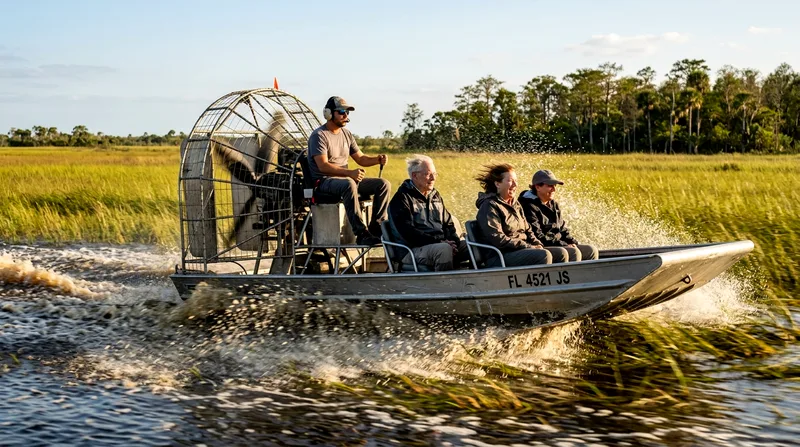
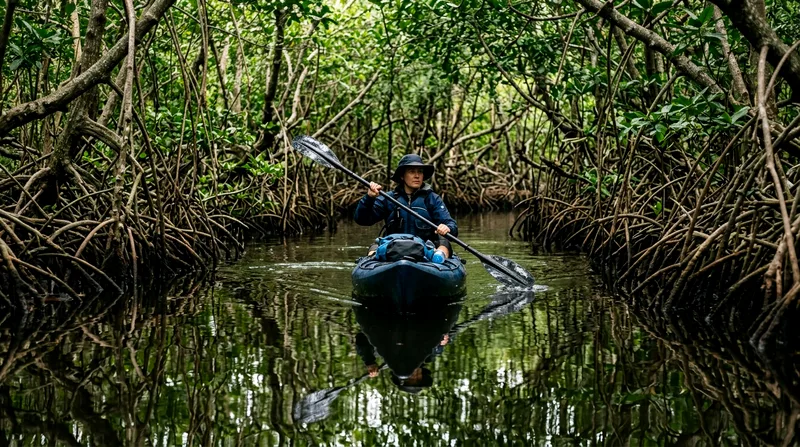
An airboat tour runs on a flat-bottomed boat with a raised fan engine, built to skim over inches of water and sawgrass at speeds up to 35-45 mph on open stretches. It's loud, it's fast, and it covers a lot of territory — often 8 to 12 miles in an hour-long tour. A kayak tour puts you at water level in a canal, creek, or mangrove tunnel, moving under your own power at maybe 2-3 mph, covering a fraction of the distance but getting far closer to herons, alligators sunning on the bank, and the occasional manatee in brackish channels near the coast.
Airboats win on speed and ease, kayaks win on proximity to wildlife and quiet immersion.
Everglades airboat vs kayak tour comparison by cost, time, fitness, and wildlife access
| Tour Type | Typical Duration | Approx. Price Range | Fitness Level | Wildlife Proximity | Noise Level |
|---|---|---|---|---|---|
| Airboat tour | 45 min - 1.5 hrs | $35-$75 per person | None required | Moderate, from a distance | High (engine noise) |
| Guided kayak tour | 2-4 hrs | $50-$120 per person | Moderate, paddling required | Close, eye-level | Very low (silent) |
| Self-guided kayak rental | 2 hrs - full day | $20-$45 per rental | Moderate to high | Close, eye-level | Very low (silent) |
| Combo airboat + swamp walk | 2-3 hrs | $60-$100 per person | Light walking | Moderate | High during airboat segment |
Prices and durations vary by operator and season; check current prices and availability before booking.
What you get with each
Airboat tours typically run 45 minutes to 1.5 hours, with operators based near the park's edges along Tamiami Trail or in Everglades City. Expect a guide narrating over the engine noise (sometimes through headsets), a stop or two to cut the engine and scan for alligators, and a ride that feels more like an attraction than a nature walk. Kayak tours range from a 2-hour guided paddle to a full-day outing, sometimes self-guided with a rented kayak from a park concession. You get silence between paddle strokes, the ability to stop anywhere, and a slower pace that rewards patience over distance.
Key differences at a glance
Noise is the biggest divide — airboats are genuinely loud, often in the 90-100 decibel range near the engine, while kayaks are silent except for water on the paddle. Access differs too: airboats legally operate only in designated areas of the Everglades (not within the national park's protected airboat-free zones, which cover most of the interior), while kayaks can enter narrow mangrove creeks and backcountry trails airboats can't reach. Physical demand is the other major factor — airboats require zero effort, kayaks require sustained paddling and some upper-body stamina.
Wildlife Viewing and Access
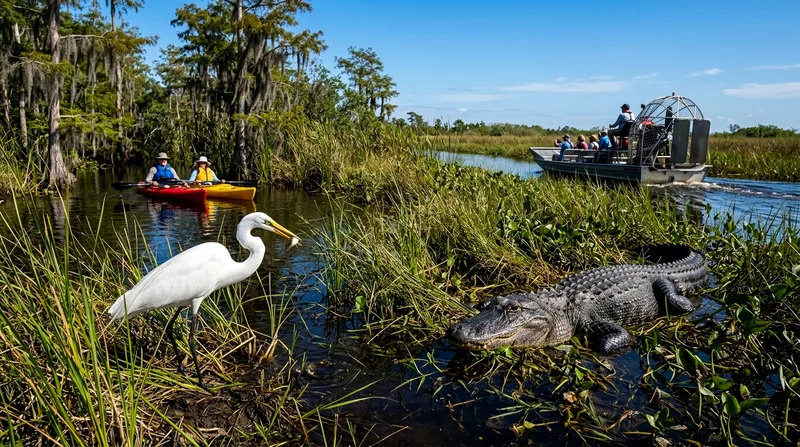
If the main goal is Everglades wildlife viewing, the honest answer is that both deliver alligators reliably — they're the one species you'll almost certainly see either way, sunning on banks or drifting in canals along Tamiami Trail. Where the experiences diverge is everything else: wading birds, manatees, and the subtler stuff that spooks at the sound of an engine.
Airboat advantages
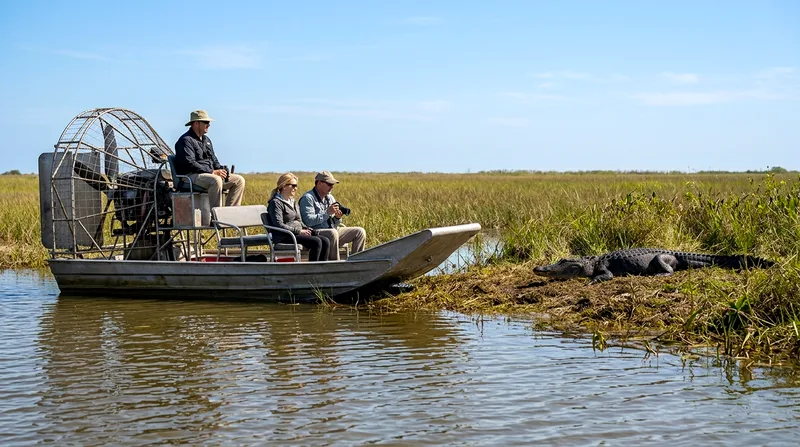
Airboats cover ground fast, which matters when alligators are the priority and you have limited time. Guides know where gators congregate and can reach several spots in one short ride, cutting the engine to drift and point out wildlife. On a hot afternoon when animals are less active and scattered, covering more territory can actually mean seeing more alligators than a kayak tour confined to one creek. Airboats also work well for anyone who can't paddle but still wants to get out past the boardwalks.
Kayak advantages
Kayaks get far closer to wading birds — herons, egrets, wood storks — because there's no engine noise to trigger a flight response. Paddling through mangrove tunnels near the Ten Thousand Islands also puts you in prime manatee territory in cooler months, something airboats rarely access since those channels are too narrow. The trade-off is unpredictability: a quiet morning paddle might turn up less overall animal volume than a fast airboat sweep, but what you do see, you see up close and for longer.
Cost, Time, and Physical Effort
Budget and stamina often decide this faster than wildlife preference does. Airboat tours are generally cheaper per hour and require no physical input, which makes them the default choice for families juggling nap schedules or senior travelers who don't want to paddle in Florida humidity. Kayak tours cost more per hour of guided instruction but can be cheaper if you rent and self-guide — though that requires some navigation confidence in a marsh where channels look identical after the first bend.
Price and duration
Expect to pay roughly $35-$75 for a standard airboat tour of 45 minutes to 90 minutes. Kayak tours with a guide run $50-$120 depending on length and whether it includes transport to a put-in point near Flamingo or Everglades City. Self-guided rentals are the budget option at $20-$45, but you're on your own for route-finding and tide timing — get this wrong near the coast and you can fight a strong outgoing current for an hour. Always check current prices and availability before booking, since fuel surcharges and seasonal rates shift both options.
Fitness and skill requirements
Airboats require nothing beyond sitting down and holding on around turns — genuinely accessible for wheelchair users with transfer assistance on most boats, infants on laps, and older travelers with joint issues. Kayaking demands sustained paddling, usually 2-4 hours including rest stops, and some basic ability to steer in current or light wind. It's not extreme — most healthy adults manage it fine — but it's a real workout, and anyone with shoulder or back problems should rent a tandem kayak or skip it for the airboat instead.
Crowds, Noise, and Eco-Impact
This is where the airboat vs kayak question gets less about preference and more about values. Airboats are a commercial attraction model — group tours, scheduled departures, multiple boats running simultaneously out of the busier operators near the Tamiami Trail entrance. Kayak tours run smaller, often six to twelve paddlers per guide, and self-guided rentals mean you might have a stretch of sawgrass marsh entirely to yourself.
Visitor volume and experience
Expect company on an airboat — it's a group experience by design, often 10-20 passengers per boat, with several boats cycling through popular routes on busy weekends between December and April. That's fine if you want a social, quick outing, but don't expect solitude or a personalized pace. Kayak groups stay smaller because guides can only safely manage a limited number of paddlers in current, and the physical effort naturally filters out larger families with very young children, which keeps the experience calmer.
Environmental considerations
Airboats are controversial inside the park's ecological community — the engines disturb nesting birds and can damage shallow-water vegetation beds if operators stray off marked routes, which is part of why licensed airboat tours are restricted to specific areas outside the most sensitive interior zones. Kayaks leave essentially no wake and no noise footprint, which is why park rangers and most wildlife biologists will tell you paddling is the lower-impact way to see the Everglades. If minimizing disturbance matters to you, that's a real point in the kayak's favor, not just marketing language.
Who Should Choose Each Option
Neither tour is objectively "better" — they answer different questions. An airboat tour answers "how do I see the Everglades in under two hours with zero effort?" A kayak tour answers "how do I get close to this place rather than just look at it?" If you're weighing this against other Florida day trips — say, a Key West snorkel excursion or a Fort Lauderdale boat tour — know that the Everglades experience is the one built around wildlife density and marsh ecology, not beaches, so pick the format that matches why you're going at all.
Best for airboat tours
Choose an airboat tour if you're visiting Miami on a tight schedule and want to pair it with other half-day activities — a morning airboat ride followed by an afternoon in Miami Beach is a realistic combination. It also suits families with kids under eight who'd struggle to sit still in a kayak, senior travelers who want wildlife access without physical strain, and anyone whose main goal is a guaranteed alligator sighting rather than a deep nature experience. Groups and bachelor or birthday parties also gravitate here for the thrill factor.
Best for kayak tours
Choose a kayak tour if you're a couple wanting something quieter than a typical Florida excursion, a photographer who needs proximity and stillness to get usable shots of wading birds, or an angler and sportsman type who's comfortable in a boat and wants to scout the backcountry waterways the Ten Thousand Islands are known for. Fit solo travelers and world travelers who've already done a generic airboat ride elsewhere — Louisiana's bayous offer similar rides — will likely find the kayak the more memorable, less repeatable experience.
Frequently asked questions
Which tour sees more wildlife, airboat or kayak?
Airboats usually produce more total sightings because they cover more distance fast, which helps on hot afternoons when gators are scattered. Kayaks produce closer, longer encounters with birds and manatees since there's no engine noise to scare them off. For raw alligator counts, airboats edge ahead; for quality and variety of close encounters, kayaks usually win.
Is a kayak tour harder than an airboat tour?
Yes, noticeably. A kayak tour demands 2-4 hours of steady paddling, some core and shoulder stamina, and basic steering skill in light current. An airboat requires no physical effort beyond sitting and holding the rail on turns, making it the easier option for seniors, young kids, or anyone with mobility limitations.
Are airboat tours loud and disruptive?
Yes — airboat engines run loud, often in the 90-100 decibel range near the motor, and operators typically provide hearing protection or headsets for narration. That noise is also why airboats are restricted from the park's most sensitive interior habitat and why kayaks get closer to skittish birds.
Can families with young children do both tours?
Airboats work well for young kids since there's no paddling involved and rides run under 90 minutes; most operators set a minimum age or require a lap-held infant policy, so check before booking. Kayak tours are tougher for kids under eight unless riding tandem with an adult doing the paddling, and even then, attention spans fade after an hour.
Which tour is better for photography?
Kayaks, generally. The slower pace, eye-level perspective, and silence let birds and alligators stay put instead of fleeing an engine, giving photographers more time to frame shots. Airboats make good action and scenery shots but rarely allow the stillness needed for close wildlife photography.