Compare Miami hop-on hop-off bus operators, routes, and ticket prices. Find the best sightseeing pass for your trip with our complete guide.
What is a Miami hop-on hop-off bus tour?

A Miami hop-on hop-off bus tour is an open-top or double-decker bus service that loops through the city's main tourist areas on a fixed route, stopping at marked points where you can get off, explore, and reboard a later bus using the same ticket. It's built for visitors who want a structured overview of Miami without driving themselves or paying for a private guide.
The appeal is flexibility within limits. You buy one pass, not individual tickets for transport between neighborhoods, and you can spend twenty minutes or three hours at any stop before catching the next bus, which typically arrives every 20 to 45 minutes depending on the route and time of day. That interval matters — Miami traffic on the MacArthur or Venetian Causeway during afternoon rush can stretch wait times, so don't plan a tight schedule around exact timing.
Compare this to Los Angeles, where hop-on hop-off routes struggle against the sheer scale of the city and freeway distances; Miami's tourist core is more compact, concentrated between Miami Beach, Downtown, and a handful of inland neighborhoods, which makes the format work better here than it does in LA. It's closer in spirit to what you'd find in Key West, just on a bigger scale with double-decker buses instead of trolleys.
How the system works
You buy a pass valid for a set number of consecutive days — commonly 24, 48, or 72 hours from first use, not calendar days. Scan or show your ticket when boarding, pick a seat (top deck for views, lower deck if it's raining or you want air conditioning), and ride until you want to get off. At that stop, you exit and explore on foot, then return to the same stop to catch the next bus on the loop. Most tickets include an audio commentary via headphones or an app, narrated in multiple languages, which helps European travelers who don't want a live English-only guide.
Coverage and route overview
Most Miami hop-on hop-off routes cover two overlapping loops: one through Miami Beach and South Beach's Art Deco Historic District, and another through Downtown Miami, Wynwood, and sometimes Coral Gables or Coconut Grove. Some operators link the two loops with a single transfer point near the MacArthur Causeway or American Airlines Arena, so check whether your pass includes both loops or just one — this is the single biggest source of buyer disappointment.
What's included and excluded on a Miami sightseeing bus pass
Knowing what a pass actually covers prevents an expensive surprise at the dock or museum door. Hop-on hop-off tickets are transport-and-narration products, not all-access attraction passes, and treating them as the latter is the most common mistake first-time buyers make.
Typical inclusions
Expect unlimited reboarding for the duration of your pass, recorded multilingual audio commentary, a printed or digital route map, and stops at or near major landmarks: Ocean Drive and the Art Deco Historic District, Lincoln Road, Downtown Miami's Bayside Marketplace area near Biscayne Bay, Wynwood's mural district, and sometimes a Little Havana or Coral Gables stop on an extended loop. Some passes bundle a one-time hop-on boat tour of Biscayne Bay or a discount voucher book for restaurants and smaller attractions — worth checking since it can tip the value equation in your favor.
What you won't get
Admission to paid attractions — the Vizcaya Museum, Phillip and Patricia Frost Museum of Science, or boat tours beyond any bundled voucher — is not included and must be bought separately. Hotel pickup is rare; you walk to a designated stop. Night buses are limited or nonexistent on most routes, so if you want Miami's nightlife corridors after dark, you're relying on rideshare, not the bus. I'd also flag that neither Wynwood's gallery interiors nor Little Havana's Calle Ocho walking sections are covered beyond a drop-off point — the bus gets you there, not through it.
Comparing Miami bus tour operators
Miami has had a handful of hop-on hop-off operators over the years, and the market has consolidated somewhat, but you'll still typically see at least two competing double-decker brands advertised near South Beach hotels and at kiosks on Ocean Drive. They differ mainly in route emphasis, not in the basic mechanics of the product.
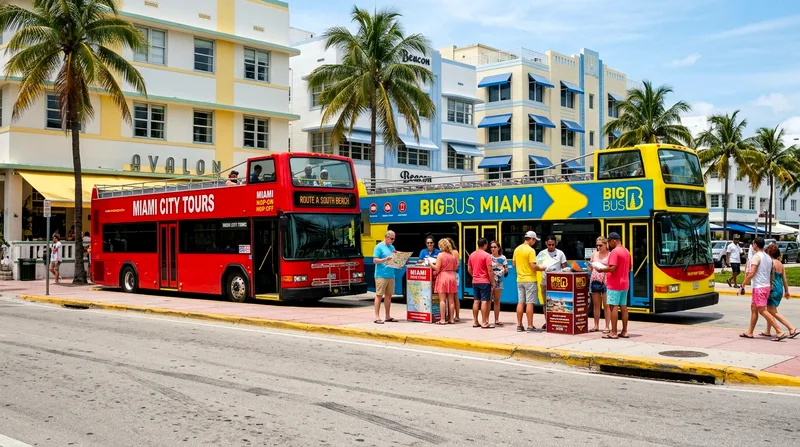
Route coverage and pass length vary more between Miami hop-on hop-off options than price does, so match the loop to your neighborhoods of interest first.
Miami hop-on hop-off bus tour routes and pass options compared
| Route/Pass Type | Typical Duration | Core Neighborhoods Covered | Best For |
|---|---|---|---|
| South Beach loop | 24 hr | South Beach, Art Deco District, Lincoln Road | Short stays, beach-focused visitors |
| Downtown/Wynwood loop | 24-48 hr | Downtown Miami, Wynwood, Biscayne Bay waterfront | Art and skyline fans |
| Combined dual-loop pass | 48 hr | South Beach, Downtown, Wynwood | First-time visitors wanting breadth |
| Extended multi-day pass | 72 hr | South Beach, Downtown, Coral Gables, Coconut Grove | Longer stays, repeat visits to stops |
| Bus + boat combo pass | 24-48 hr | Biscayne Bay cruise plus core bus loop | Travelers wanting a water view too |
Approximate route structures based on typical Miami operator offerings; always confirm current stops and duration on the official site before booking.
Route differences and stops
One operator might prioritize a tight Miami Beach loop with more frequent buses and shorter wait times, ideal if you're staying in South Beach and want quick reboarding. Another runs a wider loop extending into Downtown Miami, Wynwood, and occasionally Coconut Grove or Coral Gables, with longer gaps between buses — sometimes 45 minutes to an hour on the outer legs. If Wynwood's street art or Coral Gables' Mediterranean architecture matters more to you than extra beach time, check the stop list carefully before buying; not every pass reaches every neighborhood listed in this guide.
Pass duration options
Standard options run 24-hour, 48-hour, and sometimes 72-hour passes, priced roughly from the low $40s up toward $70-80 for the longest multi-day combo passes — figures that shift, so confirm current pricing on the operator's site before buying. A 24-hour pass suits someone with one free day who wants a fast overview; 48 or 72 hours makes more sense if you're splitting sightseeing across a longer stay and want to revisit Wynwood or Lincoln Road on a different day without repaying.
Where and how to buy Miami hop-on hop-off bus tickets
Buying is straightforward, but where you buy affects price, flexibility, and how easily you can get a refund if plans change.
Official operator channels
The most reliable route is the operator's own website, where you'll find the current route map, stop list, and published price before you pay. Buying directly also means your voucher or QR code links straight to their customer service if a bus skips a stop or runs late — a real possibility during Miami's afternoon thunderstorms in summer, which can bunch up buses along Ocean Drive. You can also buy at a staffed kiosk near major stops in South Beach or Downtown, which is useful if you decide on the day rather than booking ahead, though walk-up prices are sometimes slightly higher than online rates.
Third-party booking platforms
Aggregator sites and travel booking platforms often list the same hop-on hop-off passes, sometimes bundled with other Miami attractions like the Everglades or a Biscayne Bay boat tour. These can be convenient if you're already building a multi-attraction itinerary and want one checkout, but compare the total against buying direct — bundling isn't always cheaper once you account for products you wouldn't have bought separately. Always check cancellation terms; some third-party vouchers are non-refundable even if the operator's own direct booking allows changes up to 24 hours out.
Is a Miami hop-on hop-off bus tour worth it?
It depends heavily on who's asking. A family with young kids gets real value from not driving and parking in South Beach, where garages routinely run $20-30 a day. A couple on a short layover gets a fast orientation to decide where to return later on foot. An angler heading straight for a Biscayne Bay charter or a fashion-focused traveler chasing specific Wynwood galleries and Design District boutiques will find the bus too slow and too generalist for their itinerary.
Best for first-time visitors
If you've never been to Miami and have one or two days before heading to Key West or the Keys, the hop-on hop-off bus is genuinely useful — it orients you to where Downtown ends and Miami Beach begins, which confuses a lot of first-timers given the bay in between. European travelers especially benefit from the multilingual audio and not having to navigate unfamiliar road rules. It won't replace a dedicated Everglades day trip or a proper Little Havana walking tour, but as a first 24 hours, it earns its cost.
Budget and time considerations
If you're comparing against Fort Lauderdale or Naples, where walkable tourist cores are smaller, the math changes — those cities may not need a bus pass at all. In Miami, a 48-hour pass often costs less than two days of parking plus rideshare fares between South Beach and Downtown, so budget travelers come out ahead. But if you're only visiting one neighborhood — say, staying in South Beach the whole trip — skip it and walk; the bus adds little when everything's in range on foot.
Frequently asked questions
How long is a Miami hop-on hop-off bus ticket valid?
Most passes run 24, 48, or 72 consecutive hours starting from your first boarding, not from purchase or calendar midnight. Check the exact start trigger on your voucher — some activate on first scan, others on a printed date — before you plan your first boarding time.
Can you get on and off the bus as many times as you want?
Yes, that's the core feature — unlimited reboarding at any marked stop for the length of your pass. The only real limit is bus frequency; on outer loop sections toward Coral Gables or Coconut Grove, waits can stretch toward an hour, so budget time accordingly.
What attractions are included on the routes?
The bus takes you past or drops you near landmarks like the Art Deco Historic District, Lincoln Road, Bayside Marketplace, and Wynwood's mural district, but entry fees to museums, boat tours, or galleries are separate unless explicitly bundled. Always check the specific pass description for included extras like a Biscayne Bay cruise voucher.
Is a hop-on hop-off pass cheaper than individual attractions?
It's cheaper as transport than renting a car plus Miami Beach parking for multiple days, but it's not an attraction discount card unless your pass bundles vouchers. Compare the bundled extras against what you'd actually visit — paying for a boat tour voucher you skip negates the savings.
Do you need to book in advance or can you buy at the stop?
You can usually buy at a kiosk near major stops like South Beach or Downtown, but booking online ahead locks in the published price and guarantees your spot during busy periods like spring break or New Year's week. Walk-up buying is fine in slower months but carries slightly more price and availability risk.